
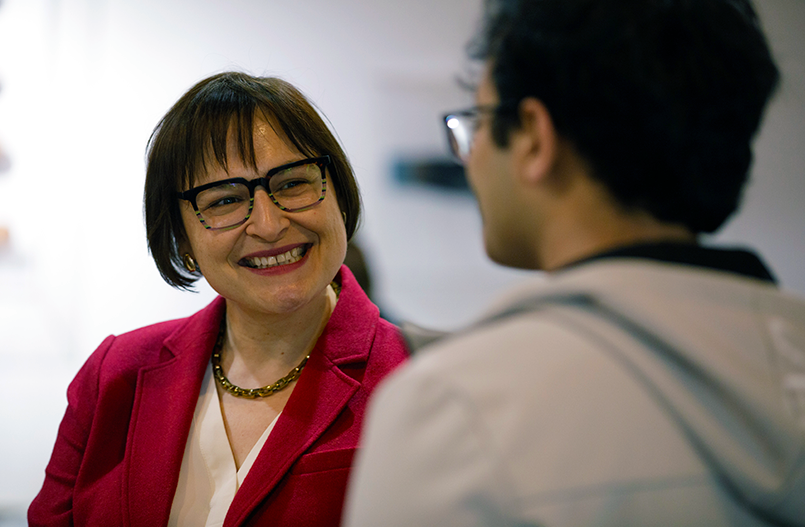
In her first interview as the newly appointed President of the Associated Colleges of the Midwest (ACM), Lisa Jasinski shares insights into her background as a first-generation college graduate, the intersection of her research interests and leadership roles, and ACM’s unique strengths. From discussing her work as a scholar-practitioner to the collective success mindset that helped build the Midwest, Jasinski provides a glimpse into her journey, priorities, and aspirations as she leads ACM into the future.
What aspects of your experience and professional background are you excited to bring to your new role?
I am proud to be a first-generation college student and graduate of Middlebury College, a residential liberal arts college in Vermont. There is no doubt that my professors and generous mentors continue to have an outsized impact on how I show up in the world and why I’ve made supporting higher education my life’s work.
For the last two decades, I have worked on small liberal arts college campuses and in large, Hispanic-serving public research universities as a strategic planner and special projects manager. At ACM, I am excited to think about how to translate my experience to support pedagogical innovation, leadership development, data sharing, inclusive excellence, and collaborative programming across fourteen truly exceptional private colleges. My superpower is designing and facilitating clear processes to bring stakeholders together to accomplish more together than we ever could alone.
You hold a Ph.D. in educational leadership and policy. How do your education and research interests inform your work as an administrator?
As a scholar-practitioner of higher education, I like to blur the lines between my professional work as an academic leader and my research. As a scholar, it’s my job to ask questions. Why are things the way they are? What evidence do we have that something is working (or isn’t)? As a practitioner, I get to do the fun, creative work of finding and adapting proven approaches to novel contexts to solve real problems. I get to write up lessons learned and talk to others about how they are approaching similar challenges on their campuses.
I’ll share an example of how I’ve done this in the past. When one of my mentors announced that he would be leaving his role as Vice President for Academic Affairs to return to the faculty, I was curious about how individuals and colleges could leverage leadership transitions for mutual benefit. Upon finding that little empirical research had been done on this topic, I decided that I would begin interviewing leaders who had returned to the faculty in public and private colleges nationwide. Seven years and more than 75 interviews later, I published this research as a book, Stepping Away: Returning to the Faculty After Senior Leadership (Rutgers University Press, 2023). I saw this project as a way to help others by providing a new theoretical framework and practical strategies to guide the actions of leaders and campuses.
When I bring my researcher’s eye to ACM, I see great potential. Research is a means to document and disseminate the good things happening across member campuses, as there are many best practices worthy of sharing. Scholarly methods—including quantitative and qualitative data collection and analysis—can be powerful tools to help faculty and staff gain an informed understanding of what is happening on their campuses. Drawing on my experience working with undergraduate researchers and graduate interns, I’m excited to explore how ACM might more actively involve students from our campuses in collecting and analyzing data.
ACM has the benefit of more than six decades of building and sustaining successful partnerships across member institutions. Our colleges are committed to thinking creatively about the enduring power and relevance of a residential, liberal arts education in the 21st century.”
—Lisa Jasinski, President of ACM
What do you see as ACM’s unique characteristics and strengths to build on?
ACM has the benefit of more than six decades of building and sustaining successful partnerships across member institutions. Our colleges are committed to thinking creatively about the enduring power and relevance of a residential, liberal arts education in the 21st century. Our member colleges come together as collaborators, not competitors. We have a long tradition of contributing to the learning and development of staff leaders. ACM isn’t afraid to rethink our operations to meet the evolving needs of students and our member campuses. We believe that to be truly excellent, we must be inclusive. And I feel so fortunate to be surrounded by a team of talented professional staff who bring great competence and passion to their work. All the pieces are here to do important things.
As an expert on academic leadership, what opportunities do you see in your role as President to support and enhance ACM faculty and staff leaders?
One of the most fun things about leading an organization is that it affords the chance to personally embody the organization’s mission, traits, and values. As ACM President, I get to live out these commitments by convening good conversation, setting the stage for impactful collaboration, asking hard questions, garnering external resources to support programming, and bringing forward relevant research and positive energy to fuel innovation. I endeavor to be a thought-partner, collaborator, and even co-conspirator in thinking through the important work of organizational change.
I want ACM faculty and staff leaders to know that I am personally invested in their individual growth and their collective achievements. I judge my own success as a leader by my ability to make our stakeholders’ work and lives easier.
You are originally from New England and most recently Texas. What has surprised or delighted you about the Midwest so far?
During the era of westward expansion, many early midwestern communities were founded on the belief of collectivism—that our communal success is more important than any of our individual achievements. This enduring value of thinking about how we all benefit has echoed throughout my early conversations with ACM stakeholders. Everyone I’ve met in my first month at ACM has made me feel very welcome, and it is so refreshing to work with colleagues who come to the table ready to collaborate and work hard together.
And what a delight it has been to arrive in Chicago during the warmest February in recorded history! Living in south Texas since 2007 has meant that my tolerance for the cold has all but disappeared. While I have deeper concerns about climate change, a mild winter has made my geographic transition much easier.
What are you especially looking forward to as you begin working with the ACM colleges, faculty, staff, and students?
In my first month, I’ve already learned so much from leaders, faculty, staff, and students from across the ACM colleges. Many of these conversations have taken place over Zoom or during programming at ACM’s offices in Chicago. Later this spring and summer, I can’t wait to get on the road to visit our member campuses to deepen my learning. There are few places in the world I love more than being on a college campus…well, maybe New Zealand (my favorite vacation destination with my husband, Patrick). For me, college campuses have always been places brimming with possibility and I find that energy infectious.
Since the pandemic, I think that many small colleges are continuing to navigate how the world and higher education has changed. As I settle into my role, I’m looking forward to creating spaces and processes to sharpen how ACM’s programmatic portfolio offers even greater value to our members considering these shifting norms and expectations. As I continue my learning, I welcome thoughts, perspectives, and suggestions from ACM stakeholders at ljasinski@acm.edu.