
The Mediterranean – a “geographical expression” surrounded by sea and mountains, rich with culture and shaped by a variety of traumatic geological events – will serve as a site, context, and inspiration for the second ACM-Mellon Seminar in Advanced Interdisciplinary Learning (SAIL) during 2013 and 2014.
The 18-month seminar, titled The Mediterranean Trivium: Earth, Sea, and Culture, will include ten days on site in Italy next summer. The site visit will focus on archeological and documentary evidence, as well as the geological and ecological record, to explore the interplay between people and the natural world over time, with a focus on Classical, Renaissance, and modern cultures.
| Read the feature article about the seminar topic & leaders! |
SAIL seminars engage ACM faculty in an environment that encourages exploration and collaboration across disciplines to promote a broader knowledge and understanding of how to engage with a subject at advanced levels, yet from multiple disciplinary perspectives. By sharing their expertise and insights, as well as the experience of being both expert and novice, participants will prepare to develop innovative multi-disciplinary courses or modules for upper-class students at their colleges – innovations that faculty at other colleges can use and build on.
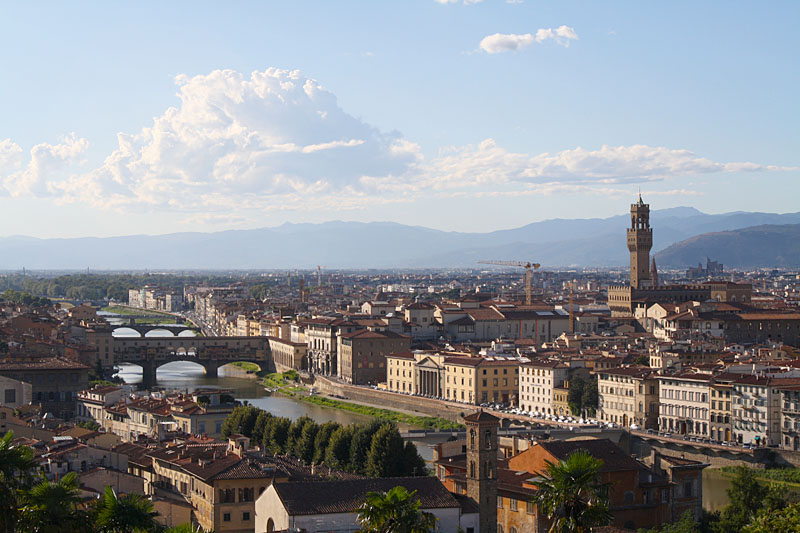 View of Florence and the River Arno.
Photo courtesy of Sarah Klooster
This will be the second of five annual SAIL seminars funded by a generous grant from The Andrew W. Mellon Foundation, and the first to use an international location. The onsite portion of Mediterranean Trivium (June 24-July 4, 2013) will be based in Florence, Italy.
Three professors from Colorado College – Susan Ashley (history), Christine Siddoway (geology), and Sanjaya Thakur (classics) – developed the topic, which was selected through a competitive process, and will lead the seminar. All three have lived and studied in Italy, and the seminar also will be able to draw on the ACM staff’s expertise in Renaissance art history and on other local specialists.
ACM has issued a call for seminar participants, seeking a total of 12 faculty from ACM colleges to join the leadership team and an ACM staff member in the seminar. Applicants will need to construct single institution teams of three, with each individual coming from a different academic division. The deadline for applications is October 29.
Approaching the seminar topic across a variety of disciplines – such as biology, ecology, economics, political science, religion, art history, and archaeology – will allow participants to gain a broader and more holistic understanding of the origins, rise, and fall of various cultures within Italy. This shared and transferable knowledge structure is the strength of liberal arts education and a primary focus of SAIL.
According to the seminar leaders, the key questions to be addressed include:
- How do natural phenomena affect societies?
- How do societies manage the environment?
- How do people think about and imagine nature?
- How do Classical and Renaissance perspectives inform contemporary society?
- How can these perspectives inform multi-disciplinary teaching practices for juniors and seniors?
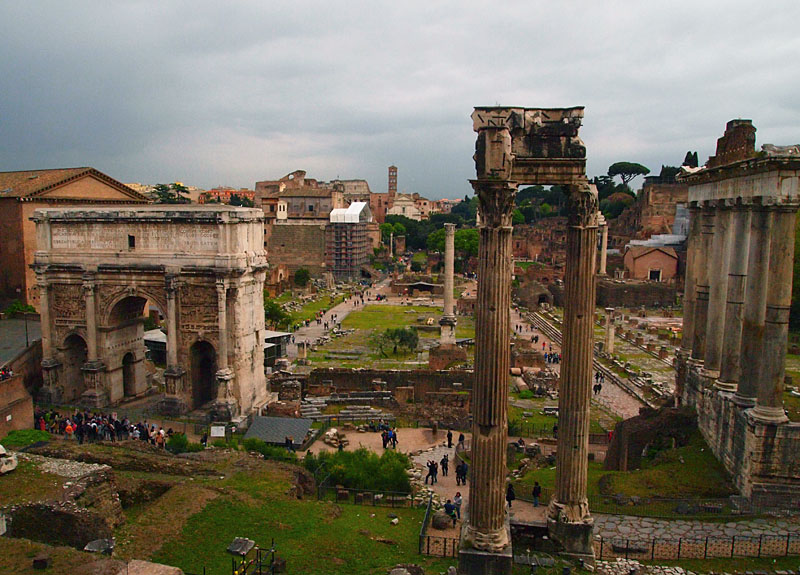 The Forum in Rome.
Photo courtesy of Samantha Stelmack
Ashley, Siddoway, and Thakur will share their expertise through onsite discussions and draw on the seminar participants’ wealth of knowledge to lead the seminar in pursuing a deep understanding of the complex interplay between natural and cultural environments and the impact they had on neighboring societies.
Planned excursions will include examining urban geology in Tuscany, overnight trips to the bay of Naples to visit Vesuvius and Pompeii, and explorations of Classical and Renaissance sites throughout Rome.
Although the ten-day experience in Italy is a highlight of the 2013 SAIL seminar, participants will be actively engaged as a learning community both before and during the year following the onsite portion of the seminar. Faculty selected for Mediterranean Trivium will provide input into the content of the seminar, will complete preparatory reading and writing assignments prior to arriving in Florence,and will share in leadership responsibilities throughout the seminar.
During the 2013-14 academic year, seminar participants will develop new curricular resources – such as courses, sequences, or modules – to engage juniors and seniors in learning the value of multidisciplinary approaches to complex problems, such as those examined in this seminar.
More details about Mediterranean Trivium and application materials are on the SAIL webpage.
Links:
- 2013 SAIL seminar on The Mediterranean Trivium: Earth, Sea, & Culture
- 2013 SAIL seminar leaders
- Feature article about the Mediterranean Trivium topic and leaders
- ACM-Mellon Seminars in Advanced Interdisciplinary Learning (SAIL)
- The Andrew W. Mellon Foundation